
Here's one way to have a successful relationship:
You share everything — and we mean everything — with your partner.
The full play-by-play of your last therapy session.
The kinky dream you had about the barista down the street.
The random looping thought that your partner may have taken up just a little too much airtime at last night's dinner with friends.
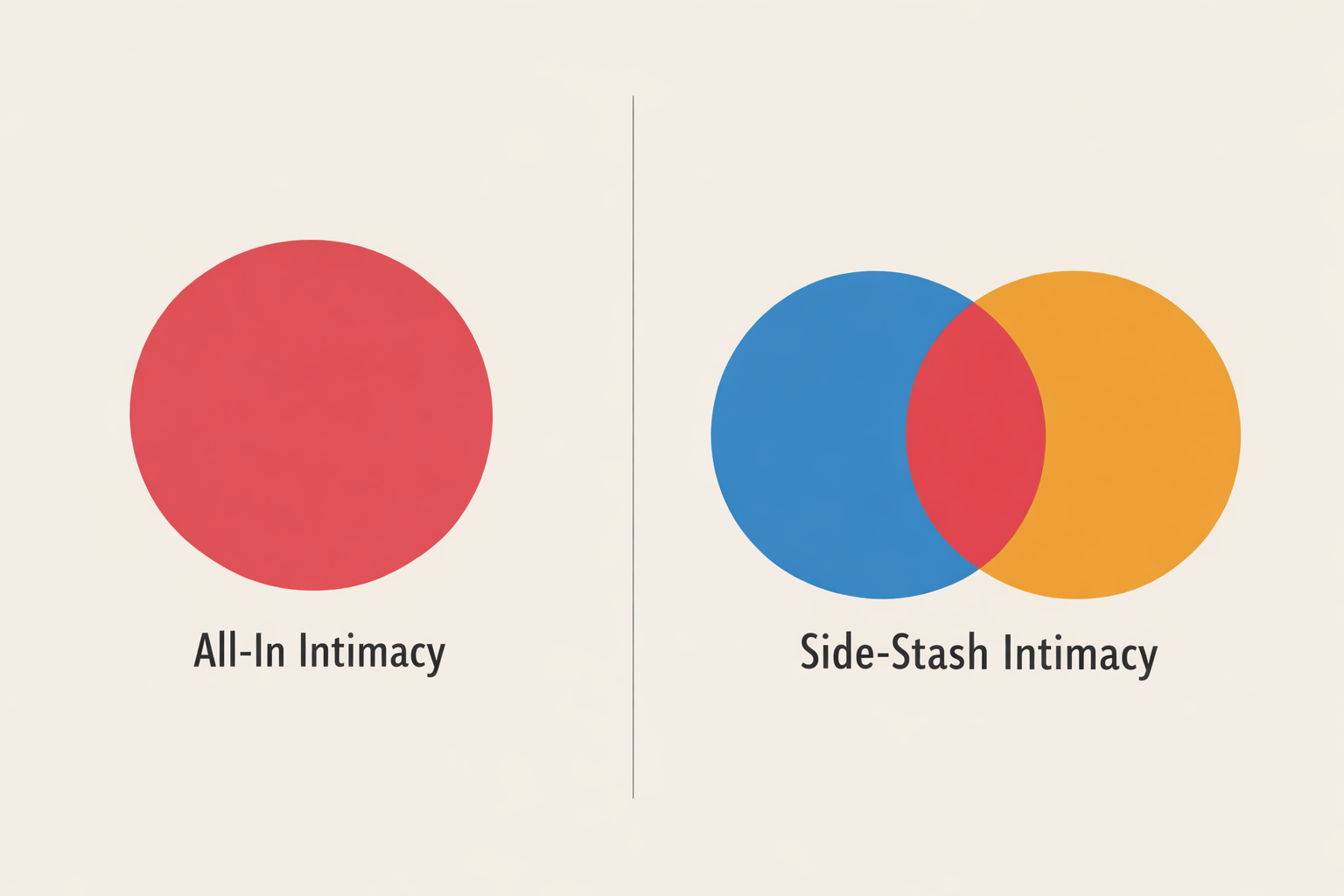
Call this all-in intimacy. It's a model where you share just about everything with your partner.
Here's another way to have a successful relationship:
You share things that are important and relevant to the relationship. But you also carve out intentional space for privacy — for thoughts, conversations, and maybe even fantasies that are never shared.
You keep the details of that vulnerable therapy session to yourself.
You share some thoughts, dreams, and desires, but keep others private.
In short, your relationship feels less like a single circle of intimacy and more like a Venn diagram, where some — but not all — of your inner worlds overlap.
Call this side-stash intimacy. It's a model where you create intentional space for both connection and privacy.
Both of these models can work beautifully as an operating system for your inner life.
There's just one catch: you and your partner have to consciously choose a model. When you don't, bad things happen.
You might, for instance, think you're living in an all-in relationship, while your partner thinks you're in a side-stash relationship. This is asymmetrical intimacy. You and your partner are playing a different game, with different rules. It's a recipe for conflict and resentment.
So you can't go wrong with either of these two models.
But you can go wrong by never making a conscious choice — by never having a clear conversation with your partner about which model of intimacy works best for the two of you.
How can you do that?
Tools
1. Reveal your ghost expectations
What are ghost expectations?
They're the expectations that live invisibly in the background. You kind of know they're there, but they're not easy to see.
In the context of emotional intimacy, these might sound like:
I want to know all about your emotional experience of each day.
I want your candid feedback — even when it stings — about how I can be a better partner.
I want to know about the full range of your desires and fantasies.
In other cases, those ghost expectations run the other way, creating space for privacy:
I don't need to know the intricacies of the drama going down at your office unless you want to share it with me.
I actually like that you have thoughts, desires, and fantasies I'll never know about.
You get the picture.
By communicating these ghost expectations, you gain clarity on whether you want the privacy of side-stash intimacy or the fuller transparency of all-in intimacy.
2. Discover your model
Few couples go fully all-in when it comes to intimacy. In fact, it's probably impossible to go all the way with this model — to share literally everything happening in your inner world.
There's almost always going to be some small patch of unshared territory. Probably for the best.
So the real question becomes:
Where do you want your ideal relationship to fall on this spectrum between all-in and side-stash intimacy?
What are the inner experiences you want to share?
What are the inner experiences best kept private?
We can't tell you what these answers are for the two of you.
But we can say that simply asking these questions creates what might be one of the most important shifts in a relationship.
It's a shift from doing intimacy by accident — where you may or may not be operating on the same model — to doing it by design, where you make a real choice.
The goal isn't to adopt your parents' model of intimacy, your friends' model, or some random influencer's model. That's just trying to win at someone else's game.
The goal is to win at your game of intimacy.
But before you can do that, you have to know what game you're playing.